Jaggery vs sugar —Most Indians grow up believing jaggery is the “healthy” sweetener — the one their grandmother used, the one Ayurveda recommends, the one that’s always framed as the wiser choice at the kirana store. The reality, though, sits somewhere between tradition and science — and if blood sugar is a concern in your household, that gap is worth understanding.
When my uncle was diagnosed with Type 2 diabetes two years ago, the first thing our family did was swap out his sugar for jaggery. It felt like the right call — natural, unrefined, “traditional.” I spent weeks researching whether that switch was actually helping him, and what I found surprised me. I’m sharing all of it here so you don’t have to piece it together yourself.
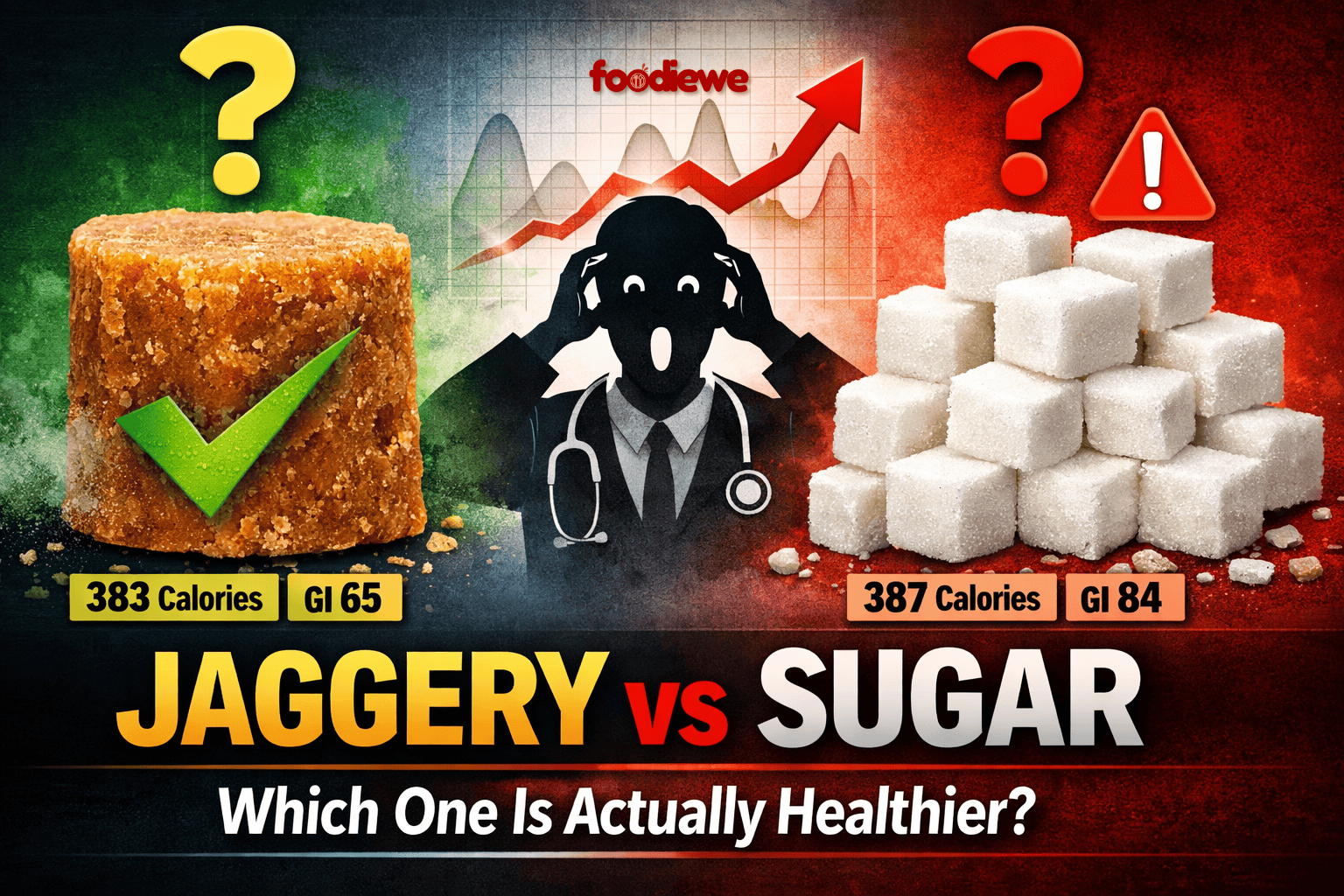
Quick Answer: Jaggery has marginally more nutrients than refined sugar — trace amounts of iron, magnesium, and potassium — but both contain nearly identical calories (~383 vs 387 per 100g) and similarly high glycemic indexes. Jaggery is not safe for diabetics as a free substitute for sugar. For most healthy people, it’s a slightly better choice, but moderation matters far more than which sweetener you pick. Here’s the complete jaggery vs sugar breakdown — calories, GI, minerals, and what it means for your health.
What Is Jaggery, and Why Do Indians Swear by It?
Jaggery — known as gur in Hindi, bellam in Telugu, and vellam in Tamil — is an unrefined sweetener made by boiling and concentrating sugarcane juice (or occasionally palm sap) without separating the molasses. That single step — not removing the molasses — is what sets it apart from white sugar. Refined sugar goes through chemical bleaching and centrifugation, stripping away virtually every mineral and trace nutrient in the process.
In Indian households, jaggery is woven into daily life in ways that sugar simply isn’t. It sweetens the post-meal paan, goes into til ladoo during Makar Sankranti, and is stirred into chai across villages and cities alike. Ayurveda has prescribed it for centuries as a digestive aid and respiratory tonic. That cultural trust isn’t unfounded — but it’s also not the full picture.
What most health blogs skip: the nutritional difference between jaggery and sugar exists almost entirely in the mineral column, not in calories or carbohydrates.
Jaggery vs Sugar: Nutritional Profile and Calories Compared
Let’s put the actual numbers on the table, because vague claims about one being “better” don’t help anyone.
| Nutrient | Jaggery (per 100g) | Refined Sugar (per 100g) |
| Calories | 383 kcal | 387 kcal |
| Carbohydrates | ~97g | ~100g |
| Sucrose | 65–85g | ~99.9g |
| Iron | 10–11 mg | 0 mg |
| Calcium | 80–100 mg | 0 mg |
| Magnesium | 70–90 mg | 0 mg |
| Potassium | ~1,056 mg | 2 mg |
| Glycemic Index | ~84 | ~65 |
Source: Indian Food Composition Tables (IFCT 2017), National Institute of Nutrition, Hyderabad; USDA FoodData Central
The single most important thing to understand: jaggery vs sugar are almost identical in calories and carbohydrate load — the 4-calorie difference per 100g is irrelevant in practice.
Where jaggery genuinely pulls ahead is minerals. A 20g serving (roughly one small piece or one heaped teaspoon) provides about 2.2mg of iron — around 12% of an adult’s daily requirement. Refined sugar provides exactly zero. The same serving delivers roughly 16mg of magnesium and 211mg of potassium, both of which refined sugar lacks entirely.
That said, per the IFCT 2017 data, these are trace amounts. You’d need to eat far more jaggery than anyone should in a day to use it as a meaningful mineral source. Think of it this way — you’re upgrading your sweetener, not adding a multivitamin to your diet.
Nutrition Note: Jaggery also retains phenolic antioxidants (from the molasses fraction) that are completely absent in white sugar. These compounds may offer modest protection against oxidative stress, though the research on this is still early.
One fact most people don’t know: jaggery’s glycemic index (GI ~84) is higher than commonly cited figures for refined sugar (GI ~65). This surprises most people. The reason is that jaggery contains a mix of sucrose, free fructose, and free glucose, while table sugar (pure sucrose) releases glucose slightly more gradually after digestion. For your body’s glucose response, the difference between the two is small — and not in the direction most people expect.
Jaggery vs Sugar in Your Indian Diet: How to Use Both Wisely
The question isn’t really whether to use jaggery — it’s how much and when. Here’s where the India-specific context matters.
In chai: Replacing one teaspoon of white sugar with jaggery in your morning cup is the single easiest, most painless switch you can make. You get a richer, slightly caramel-like flavour, a small mineral boost, and zero extra calories. For most people — two cups of chai a day with one teaspoon each — this swap is completely sensible. The benefits of jaggery in tea aren’t dramatic, but they’re real: you’re getting iron and magnesium from a food you’d be consuming anyway. Wondering exactly how much jaggery per day is safe for your specific health condition? We’ve covered the complete daily limits here.
In traditional sweets and cooking: Jaggery is the base for chikki, gur ki roti, pongal, puran poli, and dozens of regional sweets. Using it instead of refined sugar in these recipes makes nutritional sense, especially when the dish is already rich in whole ingredients like sesame, lentils, or nuts that slow glucose absorption.
The honest trade-off: Jaggery is 2–3 times more expensive than refined sugar. In recipes that use it purely as a sweetener without benefiting from its flavour — think certain baked goods — the swap may not be worth it financially or in terms of taste. And if you have diabetes, pre-diabetes, or are insulin-resistant, switching from sugar to jaggery is not a licence to use more of it. The GI is high either way. Consult a registered dietitian or doctor before making significant dietary changes, especially if you’re managing blood sugar.
For weight management specifically: don’t be fooled by jaggery’s health halo. At 383 calories per 100g, eating more of it because it “feels healthier” will still contribute to a calorie surplus. The swap only makes sense when quantities stay the same.
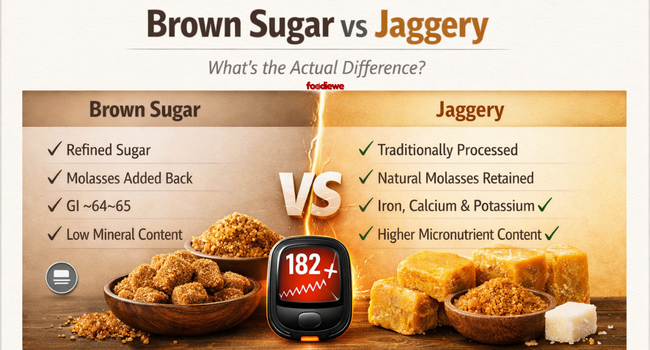
Brown Sugar vs Jaggery: What’s the Actual Difference?
In the jaggery vs sugar debate, brown sugar is often confused as a middle ground — it isn’t. This comes up a lot, so it’s worth settling clearly. Brown sugar is not the same as jaggery — not even close.
Brown sugar is refined white sugar with a small amount of molasses added back during processing. It has a marginally higher mineral content than white sugar, but far less than jaggery. Its GI is nearly identical to white sugar (~64–65), and its mineral profile is minimal. If you’re buying brown sugar hoping it’s closer to jaggery, it isn’t.
Jaggery retains the molasses naturally, never having been separated from it. This is why its iron, calcium, and potassium content is meaningfully higher. In the jaggery vs sugar debate, brown sugar sits firmly on the “sugar” side of the table nutritionally.
The hierarchy, if you must rank them: jaggery > brown sugar > white sugar — strictly in terms of micronutrient retention. But all three are sweeteners and should be treated as such.
FAQ’s
Is jaggery better than sugar for diabetics?
Not as a free substitute. Jaggery’s glycemic index (~84) is actually higher than refined sugar (~65), meaning it can raise blood sugar faster. The trace minerals in jaggery don’t offset this. Diabetics should limit both, and always check with their doctor or a registered dietitian before switching sweeteners.
How many calories does jaggery have compared to sugar?
Both are nearly identical. Jaggery has approximately 383 calories per 100g; refined sugar has about 387 calories per 100g. Per teaspoon (roughly 5g), both provide around 19–20 calories. There is no meaningful calorie advantage to choosing jaggery over sugar.
What are the benefits of using jaggery in tea?
Replacing sugar with jaggery in your daily chai adds trace amounts of iron (~1.1mg per 10g), magnesium, and potassium that refined sugar lacks entirely. It also provides a richer, caramel-like flavour. For most healthy adults, one to two teaspoons of jaggery in tea per day is a reasonable swap — but it doesn’t turn your chai into a health drink.
How much jaggery can I have per day?
Most nutrition guidelines suggest keeping total added sugar intake under 25–30g per day (WHO recommendation). That means jaggery and all other sweeteners combined shouldn’t exceed roughly 5–6 teaspoons daily for a healthy adult. Most dietitians recommend limiting jaggery to 10–15g per day (about 1–1.5 teaspoons) to get some mineral benefit without excess sugar load.
For a detailed breakdown by health condition — including diabetics, pregnant women, and weight loss — read our dedicated guide: How Much Jaggery Per Day Is Safe?
Is jaggery better than sugar for weight loss?
When it comes to jaggery vs sugar for weight loss — no. Both sweeteners are calorie-equivalent. Jaggery won’t accelerate weight loss, and its health-food reputation can lead people to consume more of it, which is counterproductive. The only sweetener strategy that supports weight loss is consuming less of all sweeteners — not switching between high-calorie ones.
The Honest Takeaway
Still confused about the jaggery vs sugar switch? The answer is simpler than most blogs make it. Swap for swap, same spoon, same amount — jaggery edges ahead. But the moment you pour a little extra because it “feels healthier,” that advantage disappears. Its mineral content is real; its calorie advantage is not. And for anyone managing diabetes or pre-diabetes, it is absolutely not a safe alternative to sugar.
Honestly, after all my research for my uncle’s situation, my recommendation to his family was this: use jaggery in chai and traditional cooking where the flavour fits, keep the quantity to a teaspoon or two a day, and focus the real energy on reducing overall sweetener intake across the board. That mattered far more than which sweetener was in the jar.
If you’re looking for healthier sweetener options for Indian cooking, small consistent changes beat dramatic swaps. Start with high-protein options like moong dal chilla that naturally need less sweetener. Bookmark this jaggery vs sugar guide and share it with someone who’s still making the switch blindly.
Found this helpful? Share it or tag us @cookwithfoodiewe — your friends probably have the same question.
Consult a registered dietitian or doctor before making significant dietary changes, especially if you have diabetes, pre-diabetes, or any metabolic condition.