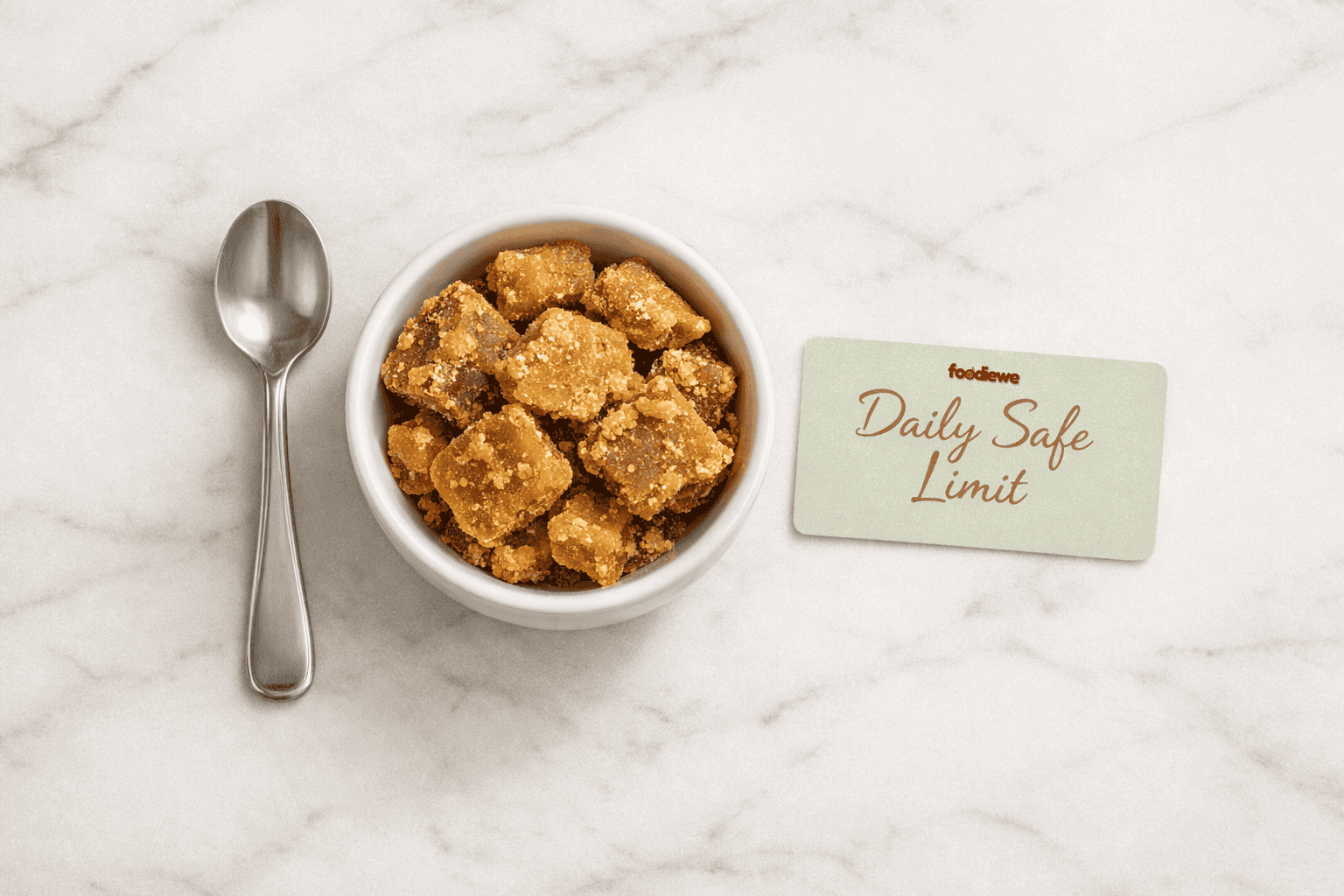
Most Indians treat jaggery as a guilt-free swap for sugar — but eating unlimited gur is not the same as eating healthy. Jaggery still contains roughly 97% sucrose by composition, which means the question of how much jaggery per day is safe matters more than most health content admits.
| Quick Answer: A healthy adult can safely consume 10–20 grams (1–2 teaspoons) of jaggery per day. For diabetics, the limit drops to 5–10 g or as advised by a doctor. For weight loss, stick to 1 teaspoon (≈10 g) maximum. Exceeding this regularly adds excess sugar to your diet, regardless of how natural the source is. |
What Is Jaggery — and Why Do Indians Use It Daily?
Jaggery — called gur in Hindi — is an unrefined natural sweetener made by boiling and concentrating sugarcane juice or palm sap without separating the molasses. Unlike refined white sugar, which loses virtually all trace minerals during processing, jaggery retains small amounts of iron, potassium, magnesium, and antioxidants from the original cane juice.
In India, jaggery sits at the intersection of food and tradition. A small piece of gur after lunch is a long-standing Ayurvedic digestive practice, and jaggery features heavily in seasonal foods — til-gur laddoos in winter, panjiri during postpartum recovery, and everyday dal-sabzi in countless households. For a detailed look at how jaggery compares to refined sugar across glycaemic index, antioxidants, and calorie content, see our full guide: Jaggery vs Sugar: Which Is Healthier in 2026?
But here’s what most health blogs skip: jaggery’s mineral content, while real, is nutritionally modest at safe serving sizes. The nutrients are a bonus — not a reason to consume it freely. This is exactly why knowing how much jaggery per day is appropriate for your body matters more than simply knowing it’s ‘better than sugar’.
Nutritional Profile of Jaggery: What’s Actually in 10 Grams?
Before deciding how much jaggery to eat per day, it helps to see exactly what you’re consuming at a 10 g serving.
| Nutrient | Per 10g Jaggery | % Daily Value (Approx.) |
| Calories | 38 kcal | ~2% |
| Total Sugar | 9.7 g | — |
| Iron | 0.3 mg | ~1.7% |
| Magnesium | 16 mg | ~4% |
| Potassium | 140 mg | ~3% |
| Calcium | 8 mg | ~0.8% |
| Phosphorus | 4 mg | ~0.6% |
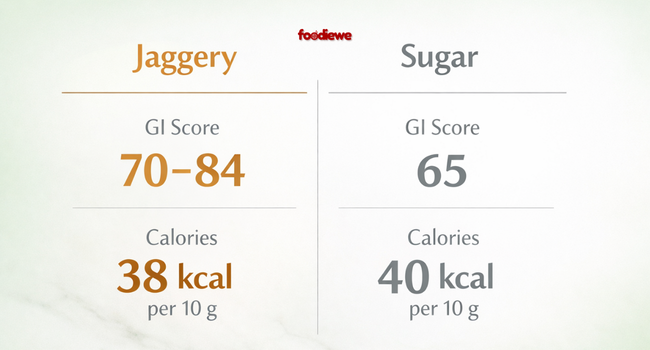
These numbers directly answer how much jaggery per day is safe to consume — because once you see 38 kcal and 9.7g sugar per 10g, the 10–20g daily ceiling makes complete sense. This is nearly identical to refined white sugar (40 kcal per 10g). The practical difference lies in the glycaemic response and trace mineral content — not the calorie count.
| Nutrition Note: Studies report jaggery’s Glycaemic Index (GI) between 70–84, compared to white sugar’s GI of ~65 — making jaggery’s glycaemic impact equal to or higher than refined sugar depending on the batch and processing method. Source: University of Sydney GI Database. |
How Much Jaggery Per Day Is Safe? Limits by Age & Health Condition
There’s no single answer that works for everyone. The right jaggery intake per day depends on your health condition and goal. Here’s a practical breakdown:
For Healthy Adults
Safe range: 10–20 grams per day (1–2 teaspoons). Registered dietitians recommend keeping added sugar — from all sources combined — under 25 g per day for adults on a standard 2,000 kcal diet. This aligns with the WHO free sugars guideline. One small piece of block jaggery typically weighs 10–15 g — so one piece a day is your ceiling, not your starting point.
For Diabetics — How Much Jaggery Is Safe?
When diabetics ask how much jaggery per day is safe, the honest answer is: very little, if any. Jaggery is not a diabetic-friendly sugar substitute, despite widespread marketing to the contrary. Its GI range of 70–84 means it can raise blood glucose quickly — comparable to or faster than refined sugar. If your doctor hasn’t restricted it entirely, a maximum of 5–10 g occasionally (not daily) is the conservative position. Always consult a registered dietitian or diabetologist before including jaggery in a diabetic meal plan.
| Important Caveat: If you have Type 2 diabetes, prediabetes, PCOS, or metabolic syndrome, jaggery should not be treated as a ‘safe sugar’. Its effect on blood glucose is similar to refined sugar in these conditions. Consult your doctor before consuming it regularly. |
How Much Jaggery Per Day for Weight Loss
People often ask how much jaggery per day for weight loss is actually acceptable. The answer: cap it at 1 teaspoon (10 g) maximum per day — and only when it replaces another sugar source, not when it’s added on top. The question of how much jaggery per day for weight loss comes down to simple calorie math — jaggery itself doesn’t aid weight loss; it’s calorie-equivalent to refined sugar at 38 kcal per 10 g. The math is simple: 20 g daily = ~76 extra calories = roughly 10 minutes of jogging to offset.
Jaggery Amount in Pregnancy Per Day
Pregnant women often ask how much jaggery per day is safe during pregnancy. For a healthy pregnant woman with normal blood sugar, 10–20 g per day is generally considered safe and provides small amounts of iron and potassium. However, if you’ve been diagnosed with gestational diabetes, avoid it entirely. It’s also worth noting that jaggery’s iron content (0.3 mg per 10 g) falls far short of the NIH’s recommended 27 mg daily iron intake for pregnant women. Jaggery is not a substitute for prescribed iron supplements during pregnancy. Discuss any dietary changes with your gynaecologist.
How to Use Your Daily Jaggery Allowance in an Indian Kitchen
The simplest way to manage your jaggery intake per day — and stay within a safe jaggery consumption per day — is to restrict it to one use — and the most practical one in Indian households is morning chai. One cup typically needs 5–8 g of sweetener. Swap white sugar for an equal amount of powdered jaggery, and your daily quota is effectively done. The flavour is earthier and slightly caramel-like — most people adjust within a few days.
A few practical tips for Indian kitchens:
- Powdered jaggery dissolves better in chai than block gur — easier to control the exact quantity.
- Don’t add jaggery to boiling milk directly — it can curdle. Stir it in after pouring.
- If you’ve already used jaggery in chai, skip it in dal or sabzi that day — don’t double up.
- Measure once. Most people are surprised to find they were consuming 40–50 g daily without realising.
Registered dietitians often suggest this one-use rule as the most sustainable way to enjoy jaggery’s flavour without overshooting the daily limit.
Best Time to Eat Jaggery — and When to Avoid It
After meals: If you’re wondering not just how much jaggery per day is safe but also when to eat it — after lunch is the answer. Eating a small piece after lunch is a traditional Ayurvedic practice, and there’s some logic to it. Jaggery may stimulate digestive enzymes and support gut motility — which is why it’s been used as a post-meal digestive in Indian households for generations. A 5–10 g piece after lunch is a reasonable and culturally grounded way to use your daily allowance.
Before bed: Not recommended, especially if you’re managing weight or blood sugar. Consuming jaggery at night means the sugar load hits when your activity level and insulin sensitivity are both lower. Research consistently shows that late-night sugar consumption has a more pronounced effect on fat storage and blood glucose than the same quantity eaten earlier in the day.
Can jaggery cause weight gain? Yes — if you eat it in excess. At 38 kcal per 10 g, jaggery consumed beyond your daily calorie budget will contribute to weight gain just like any other sugar. The ‘it’s natural so it’s fine’ reasoning doesn’t hold nutritionally. If your jaggery intake per day stays within 10–20 g and replaces rather than adds to your sugar intake, it won’t cause weight gain on its own.
Common Myths About Jaggery You Need to Stop Believing
Myth 1: ‘Jaggery doesn’t spike blood sugar.’
It does. With a GI range of 70–84, jaggery raises blood glucose at a rate equal to or faster than table sugar (GI ~65). Research suggests it may cause a slightly slower spike than pure glucose — but it is not ‘safe’ for diabetics or those with insulin resistance.
Myth 2: ‘You can eat as much jaggery as you want because it’s natural.’
Natural does not mean unlimited. Honey is natural. Coconut sugar is natural. All concentrated sweeteners contribute to your daily sugar load. The safe daily limit of 10–20 g applies regardless of how natural the source is. So when someone asks how much jaggery per day is safe — the answer is the same whether it’s organic block gur or regular jaggery powder.
Myth 3: ‘Jaggery is a good iron supplement.’
Not really. You’d need to eat over 300 g of jaggery to approach your daily iron requirement from it alone — far beyond any safe amount. Think of it as a small iron bonus, not a supplement. For real iron needs, prioritise spinach, lentils, meat, or consult your doctor about supplementation.
Myth 4: ‘Jaggery is safe for diabetics because it’s less processed.’
This is the most dangerous myth. Processing level does not equal glycaemic impact. Jaggery and sugar are both primarily sucrose — the body processes both similarly. A person with diabetes should treat jaggery with the same caution as white sugar unless specifically cleared by their doctor.
FAQ — How Much Jaggery Per Day Is Safe?
Q1. Is 2 teaspoons of jaggery safe daily?
Yes, for a healthy adult, 2 teaspoons (approximately 20 grams) is within the safe daily range. This contributes roughly 76 calories and 19 g of sugar — just under the WHO’s 25 g daily free sugar guideline. But if you’re already consuming added sugar through biscuits, packaged food, or fruit juice, factor that into your total before deciding on your jaggery quota.
Q2. How much jaggery per day for weight loss?
Keep it to 1 teaspoon (10 g) maximum — and only when it replaces another sugar source, not when it’s on top of your normal intake. Jaggery does not aid weight loss directly; it’s calorie-equivalent to refined sugar. Its only edge is a slightly richer mineral profile. Count it as part of your daily calorie total.
Q3. Can diabetics eat jaggery, and how much?
Diabetics should treat jaggery with the same caution as refined sugar. Its GI of 70–84 can raise blood glucose quickly. If not contraindicated by your doctor, a maximum of 5–10 g on occasion — not daily — may be acceptable, but this must be cleared by a registered dietitian or diabetologist. There is no established ‘safe’ daily amount for Type 2 diabetes without medical guidance.
Q4. What is the best time to eat jaggery?
After lunch is the most traditionally recommended and physiologically sensible time. A small 5–10 g piece after a meal supports digestion and keeps the sugar load manageable within an active part of your day. Avoid jaggery before bed — late-night sugar consumption has a more pronounced effect on blood glucose and fat storage when your body’s metabolic rate is lower.
Q5. How much jaggery is safe during pregnancy?
For a healthy pregnant woman with normal blood sugar, 10–20 g per day is generally safe. Jaggery provides small amounts of iron and potassium, but it cannot replace prescribed iron supplements — pregnant women need 27 mg of iron daily (NIH), and jaggery delivers only 0.3 mg per 10 g. If you have gestational diabetes, avoid jaggery entirely and consult your doctor.
Share it with someone who still thinks jaggery is calorie-free — or tag us @cookwithfoodiewe on Instagram.
For a deeper comparison of jaggery and sugar across GI, calories, and antioxidants, read our full guide: Jaggery vs Sugar: Which Is Healthier in 2026?
Conclusion
Jaggery is a better-quality sweetener than refined sugar — but the margin is narrower than most people assume. Understanding how much jaggery per day is safe starts with one simple habit — measure your portion once, pick one time of day to consume it, and treat it as a replacement for other sugar sources rather than an addition.
The evidence is consistent: how much jaggery per day is safe you consume directly shapes your blood sugar load and calorie intake. For healthy adults, 10–20 g per day is the safe ceiling. For diabetics, the answer is near zero without medical clearance. The trace minerals are real but modest — a bonus, not a justification for excess.